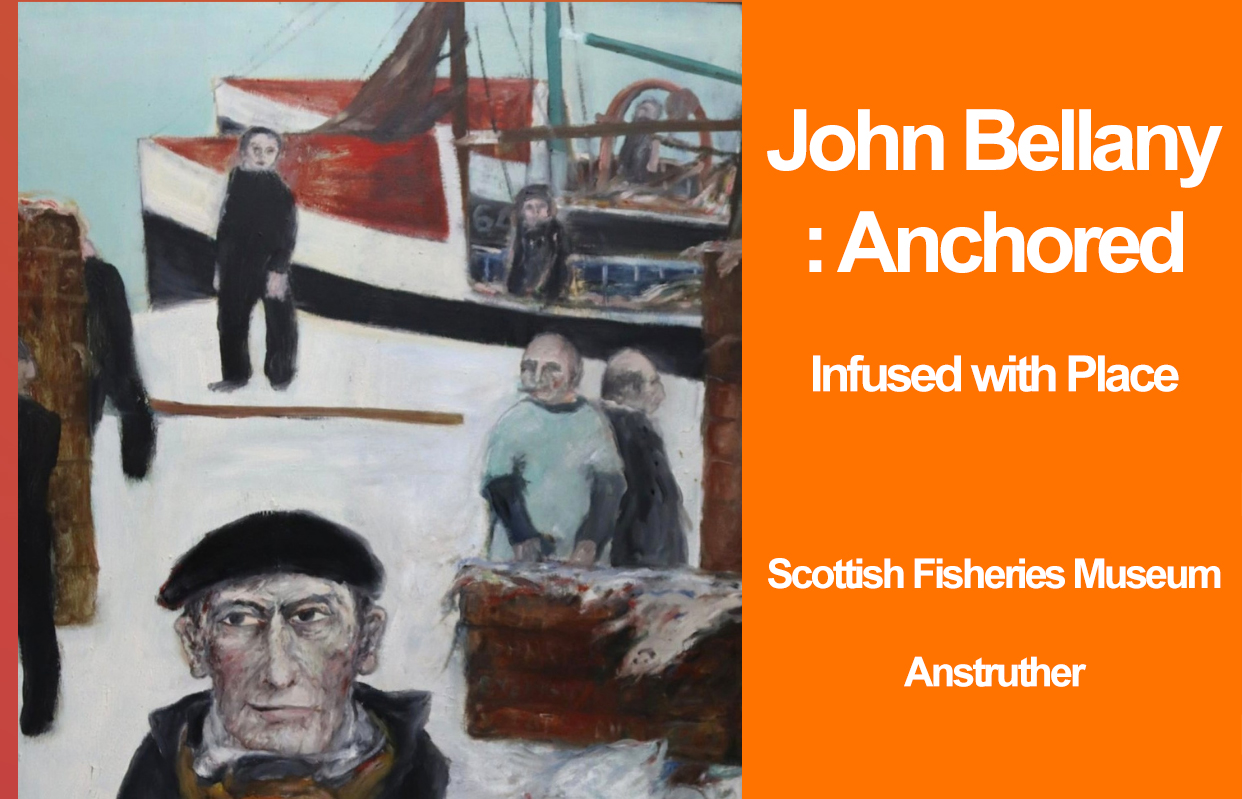
Exciting new exhibition at the Scottish Fisheries Museum. Anstruther.
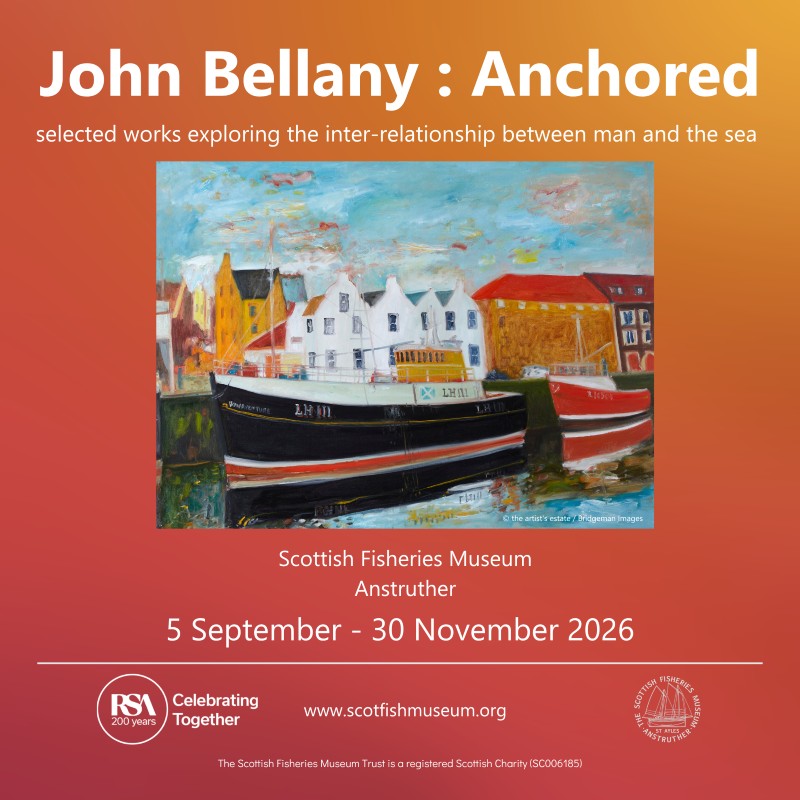
John Bellany was an artist with a unique perspective on the fishing industry and communities of the east of Scotland, having grown up within them. His works portray a deep-rooted understanding of the hardness of fishing life, but also of the physical and emotional strength and the particular imagination that sustained the people, from generation to generation, living from the sea.
This exhibition celebrates his very personal focus and brings together artwork from the museum’s collection alongside pieces borrowed from the RSA. It includes two works on public show for the first time, and spans almost the length of Bellany’s artistic career. Although the chosen works differ in subject and technique, his uncompromising study of the inter-relationship between man and the sea is a constant anchor throughout.
5 September – 30 November 2026
Scottish Fisheries Museum
Admission included with museum entry
Throughout 2026 the Royal Scottish Academy, the oldest artist-run institution in Scotland, is celebrating its 200th birthday. RSA200: Celebrating Together is a major partnership project involving more than 100 partners to celebrate two centuries of Scottish art and architecture.
Also on show is the collaborative folio “Haven” created with Bellany’s long-time friend the poet Alan Bold, together with later harbour scenes. The chosen works span almost the length of Bellany’s artistic career and, although they differ in subject and technique, his uncompromising study of the inter-relationship between man and the sea is a constant anchor throughout.
RSA200: Celebrating Together
The Royal Scottish Academy was founded in 1826 to support artists and architects and promote art and architecture in Scotland. It is an independent, non-governmental charitable institution led by Academicians. Royal Scottish Academicians are prominent artists and architects elected by their peers who govern the RSA on a democratic basis. The RSA runs a year-round programme of exhibitions, artist opportunities and events from its base at The Mound in Edinburgh.
The ambitious anniversary project is designed to bring partners and communities together to celebrate the cultural history, presence and influence of the RSA and its Academicians across Scotland. The year-long celebration is connecting and celebrating RSA artists, architects and established and emerging artists who have been part of the RSA family both historically and now. The celebration stretches across the whole of 2026 and is reaching all regions of Scotland and beyond.
Sandy Wood, Head of Collections said,
“RSA200: Celebrating Together has brought together more than 120 partners to celebrate the Royal Scottish Academy and its impact on Scottish art and culture. The project has forged new collaborations, created new art and reached new audiences, helping us imagine how the RSA can play an even greater role in Scotland’s visual culture in the future.
“It’s fantastic to be partnering with museums and galleries across the country to enable work from our collections to be enjoyed by audiences far and wide and we’re thrilled to be bringing some of John Bellany’s maritime work to the Scottish Fisheries Museum in Anstruther. We’re grateful to Museums Galleries Scotland for their support in our bicentenary celebrations.”
The exhibition John Bellany : Anchored opens at the Scottish Fisheries Museum in Anstruther on the 5th of September 2026 and will run there until the 30th of November. It is supported by a programme of events and activities.
Notes to Editors
John Bellany CBE RA HRSA LLD (1942 – 2013)
- Born in 1942, Bellany spent his formative years in Port Seton, a fishing village on the East Coast of Scotland where his father and Grandfather were fishermen and boat builders. He was first on a boat at the age of eight and the industry was to have a significant influence throughout his life.
- Staunch Calvinist beliefs were also ingrained in his upbringing. Church goers were expected to attend services three times on Sundays. Sin, death, loss, and grief were significant motifs in his work.
- From 1960 to 1965 he studied at Edinburgh College of Art where he met his future wife Helen Percy and became lifelong friends with Alexander Moffat RSA. Bellany and Moffat explored the possibilities of figurative painting and staged their ‘Railings Exhibition’ outside the National Gallery of Art during the Edinburgh Festival of 1964. They visited Buchenwald concentration camp in the late-1960s and Bellany was deeply moved by the experience.
- After graduating from ECA, he moved to London where he studied at Royal College of Art. During his teaching career he taught at Brighton College of Art, Winchester College of Art, Croydon College of Art, and Goldsmiths College.
- His drawings, paintings and printmaking remained highly expressive and autobiographical. Never more so than after a lifesaving experimental liver transplant in 1988 when he started to draw himself immediately after regaining consciousness. He went on to paint Professor Sir Roy Calne, the pioneering surgeon who saved his life as part of his ‘Addenbrookes Serious’. After discharge he saw the world in bright colours, referring to it as “seeing in cinema scope”. Further ill health was to continue, and he suffered three heart attacks throughout his life.
- His Italian home and surrounding landscapes in Barga, Tuscany offered inspiration and he painted many of its landscapes.
- Portraits of his many famous friends are held in significant collections including the National Gallery of Scotland, National Portrait Gallery and Tate Britian.
- He was elected as an HRSA in 1987.
Scottish Fisheries Museum
- The award-winning Scottish Fisheries Museum is a registered charity and home to the Scottish Fisheries Collection, a Recognised Collection of National Significance, awarded by Museums Galleries Scotland on behalf of the Scottish Government.
- It tells the story of the ‘boats, fish and folk’ of Scotland’s fishing industry, an industry which has played such an important role in the country’s economic, social and cultural life for centuries
- The Museum, which nestles on picturesque Anstruther Harbour in the stunning East Neuk of Fife, draws on a collection of some 66,000 vessels, artefacts and personal items charting Scotland’s fishing industry from the past through the present to the future
- The collection features:
- A fleet of 22 vessels of national significance listed on the UK’s National Register of Historic Vessels. The Reaper, along with Research (the last remaining first-class Zulu in Scotland) and the Lively Hope (a ring-net herring boat), hold the status of being in the prestigious National Historic Fleet of the National Register of Historic Vessels
- Fishing gear ranging from 19th century whaling harpoons and lances through to hand and steam powered lines, nets, capstans and winches, Gardner and Kelvin engines of various kinds through to a lifelike tableau of a fishmonger’s shop – the end product of the whole process
- Personal items, photographs, reminiscences and artefacts of fisherfolk as well as boat’s cabin, herring market with herring-lassies gutting and packing the catch, fish merchants, blacksmith’s workshop and 1900 Fisherman’s House, all popular with children and grown-ups alike
- Art collection including a number of important canvasses by accomplished artists such as John McGhie, John Bellany, Sam Bough, Franc Martin and Alex Watson. Works extend across oils and watercolours, pen and pencil drawings, pastel works, prints, engravings, etchings, painted signs and embroidered wall hangings
- The 10 galleries are housed in historic buildings arranged around a cobblestone courtyard connected with fishing since the 14th century. These include the sixteenth century Abbot’s Lodgings, 1724 Merchant House, storehouse of the c.1750 Anstruther Whale Fishery Company and 1900 Fisherman’s Cottage. The Historic Boatyard sits on the site of the former Alexander Aitken Boatbuilders (1927-52).
- Follow the Scottish Fisheries Museum on Facebook/scotfishmuseum, and Twitter and Instagram @scotfishmuseum
- For more information on the Scottish Fisheries Museum visit www.scotfishmuseum.org
Royal Scottish Academy
- Founded in 1826, the Royal Scottish Academy supports art and architecture in Scotland. It is an independent, non-governmental institution, governed by Members to operate on a charitable basis.
- The RSA runs a year-round programme of exhibitions, artist opportunities and events from The Mound, Edinburgh, and cares for a nationally recognised collection.
- The RSA supports artists and architects through awards, residencies, scholarships and bursaries.
- In 2026 the RSA is celebrating its 200th anniversary.
- Visit the RSA website to find out more.
- RSA on social media Facebook Instagram