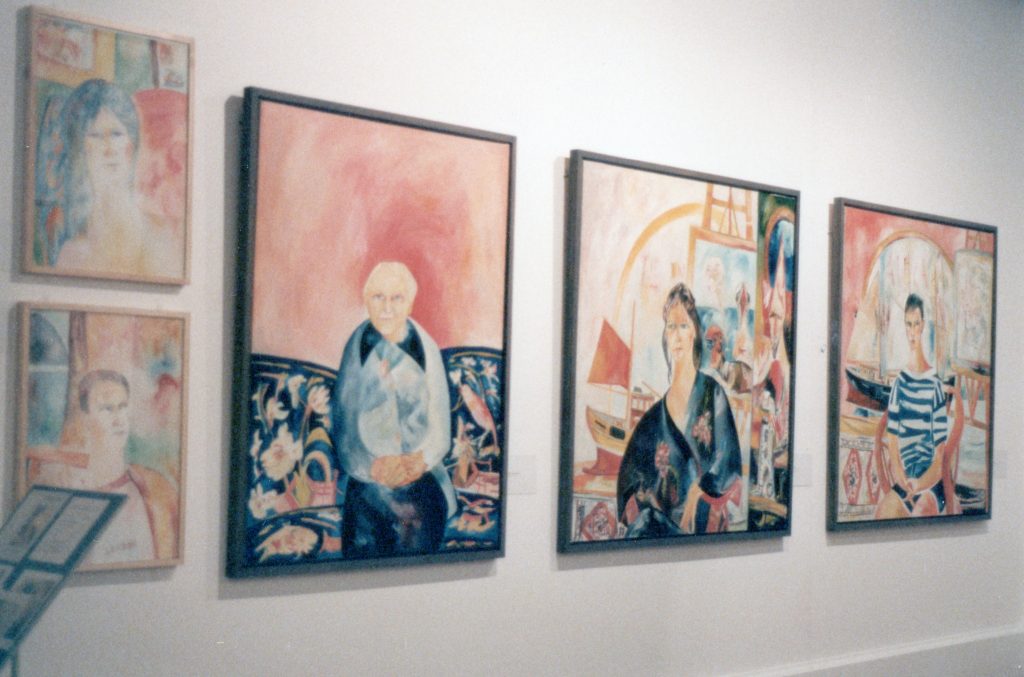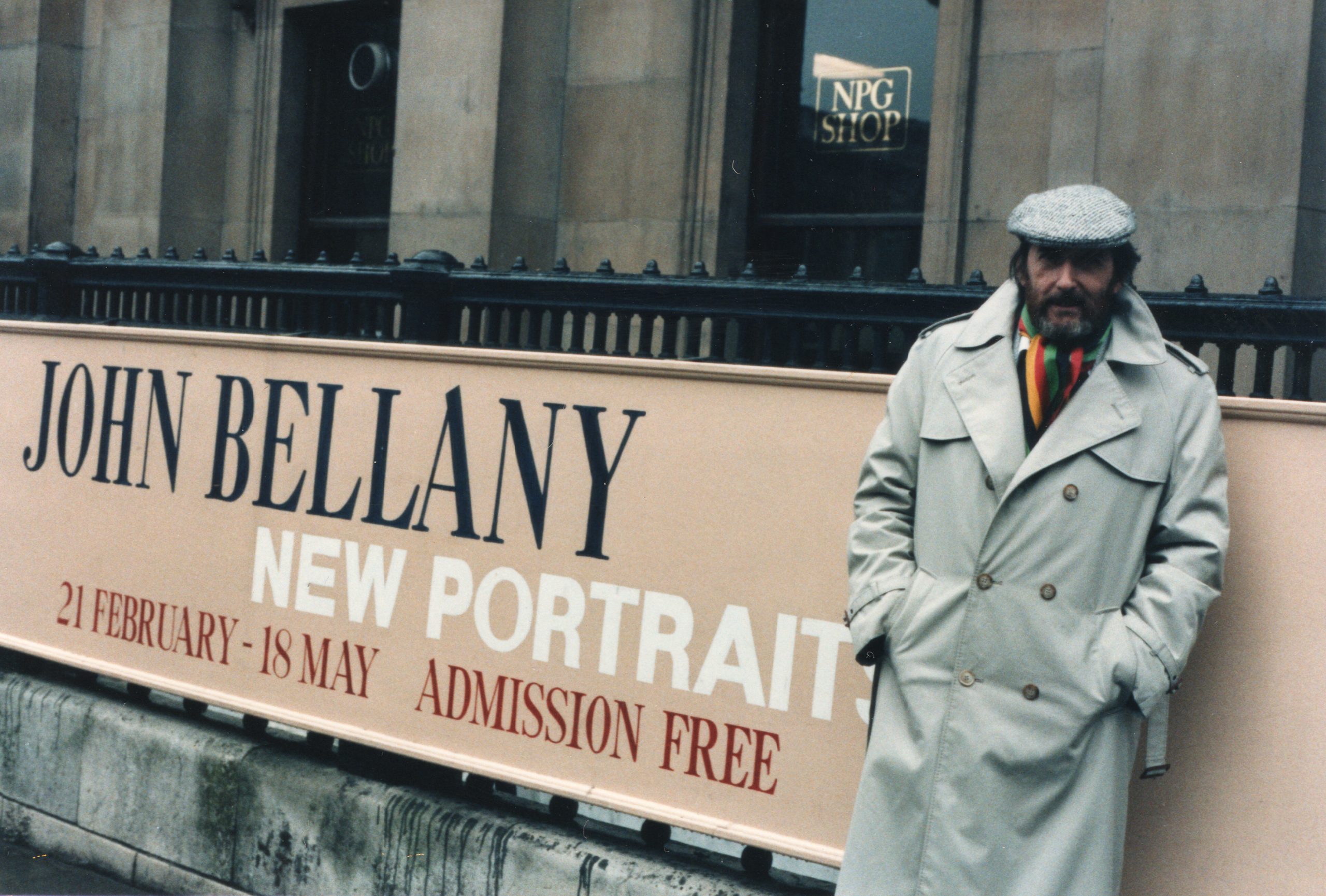
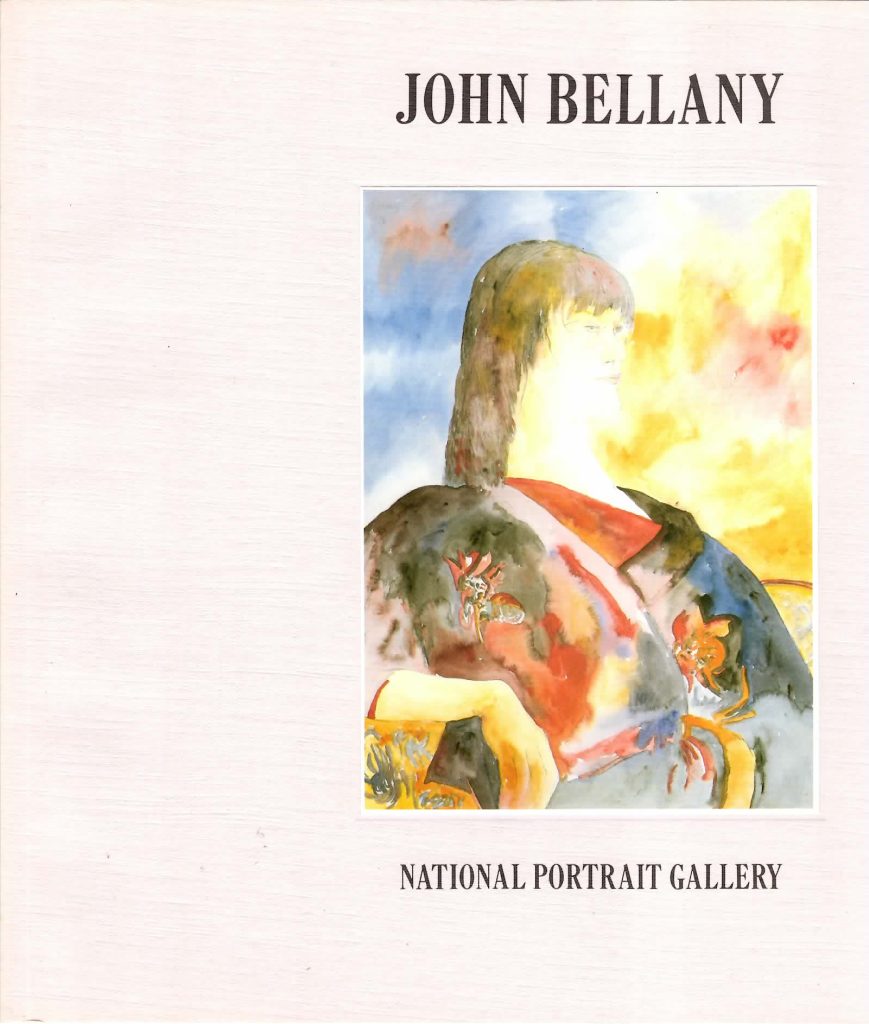
The first living artist to have a one-man exhibition at the National Portrait Gallery. 1986.
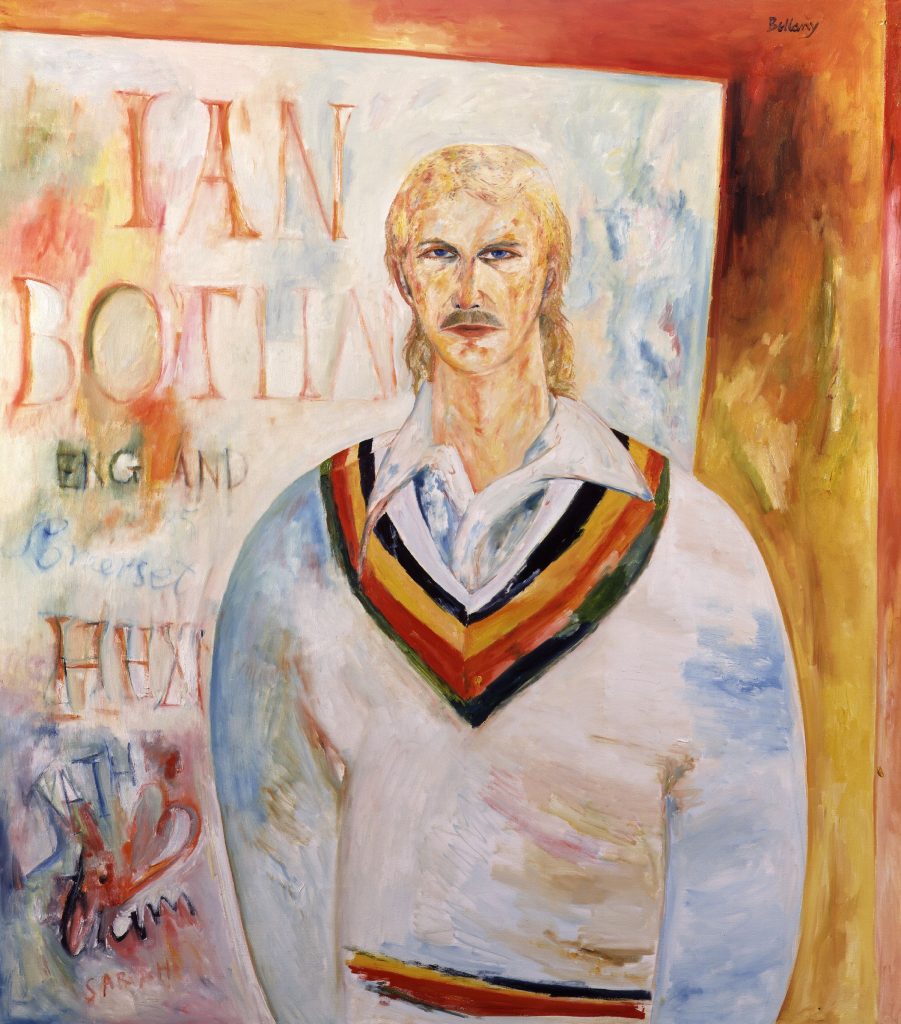
Ian Botham 172.7 X 152.4cm oil on canvas 1985
FOREWORD
Even by the standards of a full-time portrait painter, John Bellany’s work in this field over the past eighteen months or so would rank as prodigious. I could never have expected to be faced with the almost impossible task of making a selection from a range of portraits of such power and exuberance, all painted within the last year. It has been a rare privilege to observe white-hot creativity in action like this at first hand.
The National Portrait Gallery is deeply grateful to the artist, both for the opportunity to show these works and for his boundless help and enthusiasm.
Equally unexpected has been the extraordinarily generous act of patronage on the part of Mr and Mrs Timothy Hudson in acquiring these pictures and thereby also ensuring the production of this catalogue. The Gallery is grateful to them for the loan of the portraits and no less to lan Botham for agreeing to sit for the Gallery.
Both the artist and the Gallery wish to thank William Packer for his perceptive introduction to the catalogue; and without the kind co-operation of Keith Hartley and Douglas Hall, in the throes of organising their own Bellany retrospective in Edinburgh, I should not have been able to write my short essay. Our thanks are also due to Martin Shirley for designing both the catalogue and the poster, to Judith Sheppard for her capable editing, to Caroline Brown for designing and hanging the exhibition, to John Stirling for making the frames, and to the Scottish National Gallery of Modern Art for supplying figs. 1 and 2.
Robin Gibson
November 1985
INTRODUCTION
John Bellany is nothing if not a painter of figures, but so strong is the more generalised symbolic reference in his work that many with only a passing familiarity to it may be surprised to discover in him the painter of portraits. In fact his work has always been closely centred upon his own particular experience, local and domestic, long and deeply felt, and the cast of characters he calls upon has always included, whether by direct observation or half-remembered evocation, his close friends, immediate family and not least himself.
There is nothing arbitrary nor contradictory, therefore, in his making the portrait for a while his particular study and exercise. Indeed the large drawings and portraits in watercolour, made both from lite and memory, have engaged him for some considerable time and now constitute a considerable corpus in themselves. But where before they tended to be very rapid and intuitive studies that sought to conjure likeness by glancing reference, familiarity and innate facility, now the scrutiny is more concentrated, the pace of the statement slower, perhaps, and the picture-making more deliberate and attentive. The shift is one of attitude, not at all of quality, and certainly there has been no sacrifice at all of the old lightness of touch and rich fluidity of paint.
The achievement of the closest likeness has never been the point exactly, but rather the teasing suggestion of a recognisable presence; yet even so there is to all these later works a palpable quality of character and particular identity, born of a closer attention to modelling and formal observation, that is quite new in the work
What is true of the watercolours is true, writ large, of the oil paintings, as much a function perhaps of the larger scale and the more substantial medium as of any clear policy or intention. The heads indeed are now fully modelled, the space the figures occupy clearly articulated, and such added pictorial furniture as architecture, still life, homage to Van Gogh, boats in the harbour, his own picture on the wall and all manner of personal impedimenta and Bellaniana, are not in the least perfunctory in their reference, gentle though the hint may be, nor left in the least to chance.
Here with lan Botham, the public figure, is the gallery of Bellany’s private heroes – quelle galerie: wife, children and family, David Brown and Richard Morphet of the Tate, a whole palette of old artist friends and himself as Long John Silver for good measure. The characterisation is full of painterly fun, pictorial and technical wit, a gentle mocking of himself as much as anyone, and much honest affection.
The painting is yet what it always was in terms of surface and paint, the tone pitched high, the colour hot and light, the paint fat, the handling as fresh, direct and vital as ever. The touch is light still, often elegant and sometimes even effortless, it might seem, in the achievement of its effects; but all is worked, for there are no short cuts or easy generalisations to be had. There are instead a new certainty and clarity to the work, of purpose as well as vision, that are perhaps its most distinctive and impressive qualities.
William Packer
Clapham, December 1985
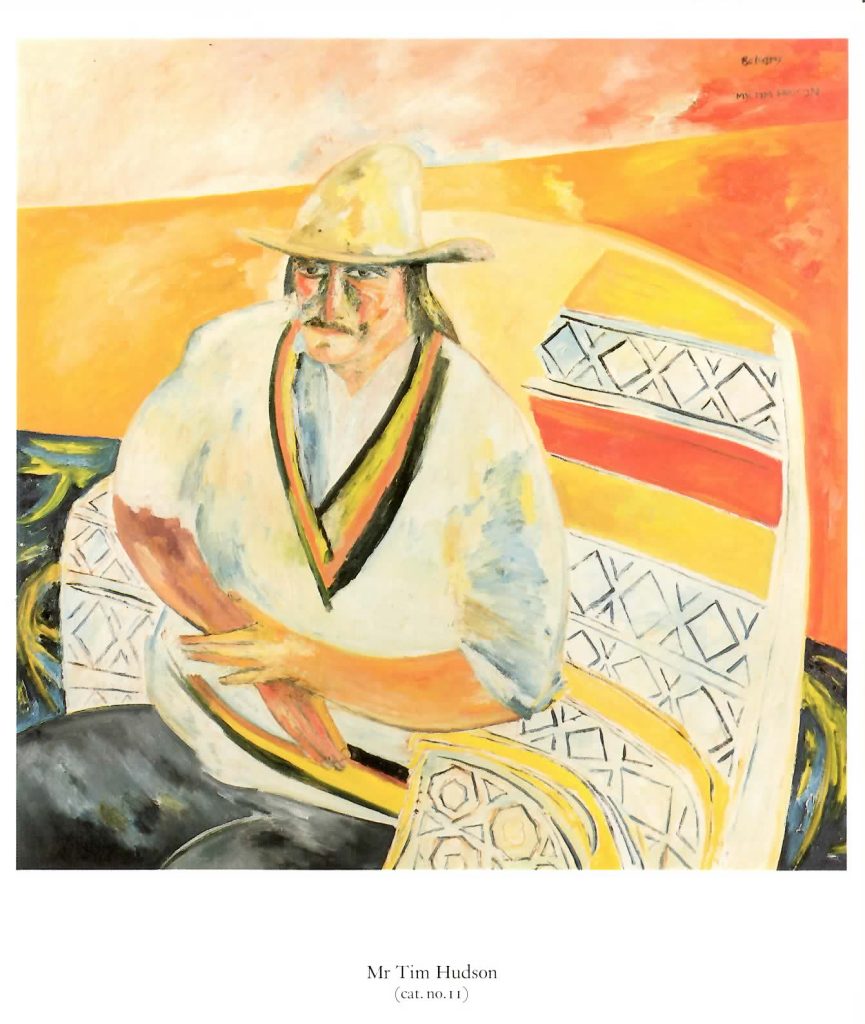
Tim Hudson oil on canvas. 152.7 X 152.7cm 1985
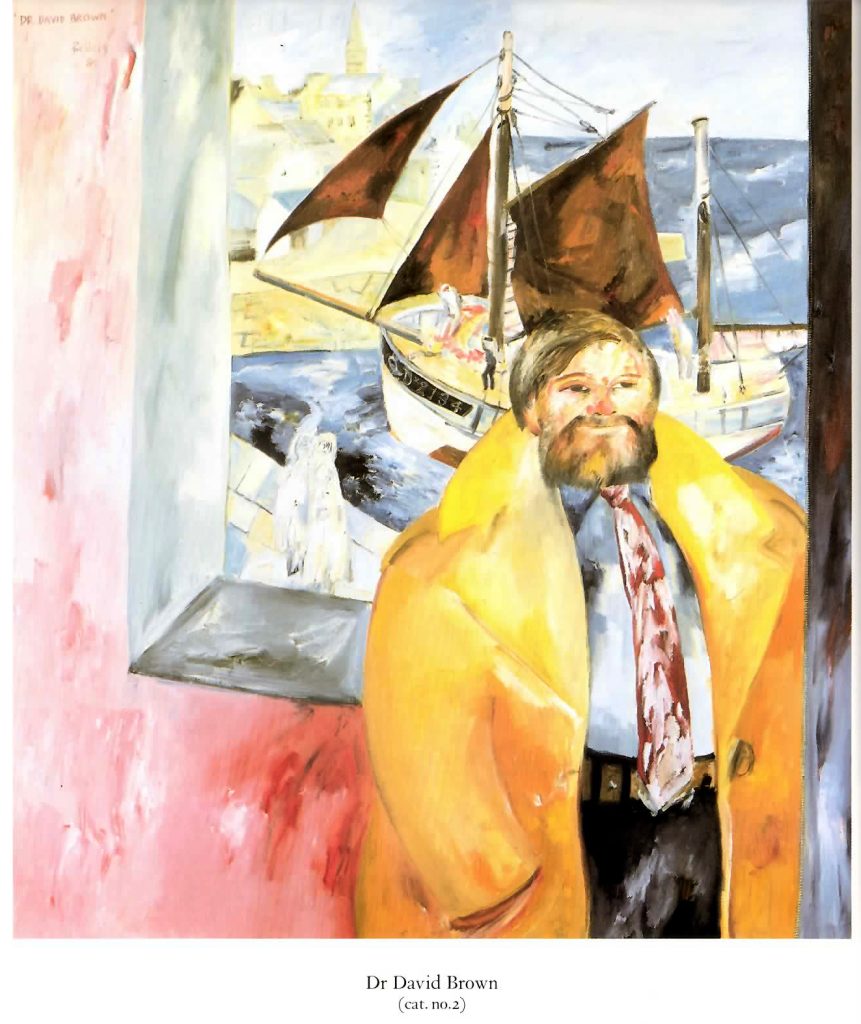
Dr David Brown oil on canvas 173 X 152.4cm 1985
BELLANY’S PORTRAITS
Informed art critics, when discussing the National Portrait Gallery’s modern collection, have tended to stress only its artistic mediocrity and to ignore both the Gallery’s archival function as a museum of people who have made British history and, more seriously, the social and cultural background to the production of those portraits in its collection. Similar criticisms have been levelled at the annual John Player Portrait Award for young portrait painters, although by the very nature of competitions, and especially in one devoted to a single limited aspect of painting, it would be optimistic indeed to hope for a string of masterpieces. What is useful and, it seems to me, valuable in such an Award, is that it not only provides an outlet for many talented young artists to try their strength against their peers but also acts as a mirror of current trends in painting, especially of the human figure.
If the mirror sometimes seems to reflect a fairly low common denominator, it has nevertheless also included a number of distinguished works, among them two highly individual paintings by John Bellany, the bulk of whose astonishing oeuvre lies well outside the normally accepted confines of the National Portrait Gallery. If middle age had not barred him from the competition, we should doubtless have seen more of his work in the Gallery in the past few years, for he is an artist to whom the art of portraiture in its widest sense is a vital part of his creative life.
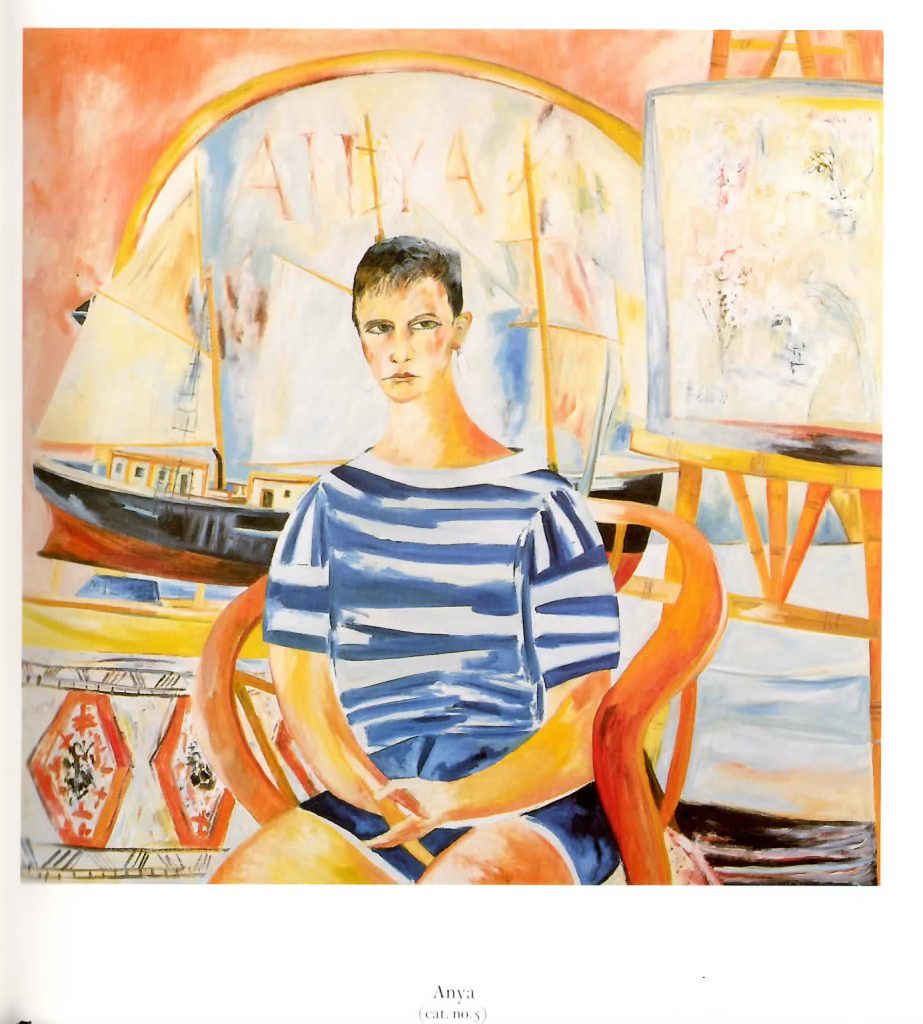
Recently, an increasing number of his paintings have carried the word ‘portrait’ in their title, and the present exhibition will provide an opportunity to see a selection of those produced during 1985.
It is perhaps only in the last hundred years that we have generally been able to accept that there is more to a great portrait than the skilled creation on canvas, paper or in clay, of a speaking likeness; and if such a judgement has been applied retrospectively and often reluctantly to a number of unconventional masterpieces from Van Gogh to Bacon, we should not be surprised if there is still resistance to the idea that the term ‘portrait’ should be applied to anything other than a meticulously rendered photographic likeness. The fact, however, that the number of such portraits produced in the last hundred years and which might also be classified as great works of art could probably be counted on the fingers of one hand is indication enough that the mere recording of physical details in a pictorially attractive manner is no longer adequate for the creation of a viable artistic statement in the age of the photograph and the video film. Portraits by a basically romantic artist of our time such as John Bellany are not passports for instant recognition and admittance into a given social and cultural milieu but personal statements by the artist about himself and his friends, and a re-creation in his own pictorial terms of his ideas and reactions to the subject. The resulting picture is first and foremost a painting by John Bellany, as much autobiographical as biographical, in which a record of the particular has been transformed into a more universal image by one man’s private vision.
Bellany has indeed much in common with Beckmann and Bacon where the self-portrait is central to both artists’ oeuvres and where often complex imagery is sometimes overpoweringly subjective.
Like them, Bellany belongs to that current of northern European painting, usually, but not always accurately, classified as expressionism and echoes of many other major artists including Munch, Ensor and Kirchner may be found in his work. His own particular background of the small Scottish fishing village of Port Seton, with the harsh realities of the fishermen’s lives and dominant Calvinist religion, has influenced the formation of his highly personal imagery and preoccupation with the sea, and has led to a series of masterpieces quite unlike anything else in contemporary painting. Although his pictures are often very large and vigorously painted, they have a raw power and immediacy far removed from the sometimes rather fey productions of the New Imagists to which Bellany might have been expected by age and artistic antecedents to be related.
The forthcoming retrospective of Bellany’s work to be organised by the Gallery of Modern Art, Edinburgh, 1986 will allow most of his major paintings to be seen in context. The extraordinary fertility both of his output and of his imagination is beyond the scope of this exhibition of recent paintings and, in the absence of documentation to date, the development of portraiture as a theme in Bellany’s work can only here be hinted at. If, as stated, portraiture has always been central to his oeuvre, it is only recently that he has begun painting a greater number of friends outside his immediate family. Five portraits were included in the exhibition organised by the Ikon Gallery, Birmingham in 1983 and they dominated the show of drawings at the Pier Gallery, Orkney, the following rear. As in the elaborate triptychs and allegories of Max Beckmann, however, the artist himself has often appeared in many of his works, either recognisable and bearded, or in mythical guise, hooded and masked as a sea bird or animal (eg. Celtic Feast, 1975, Sheffield City Art Galleries). Such’walk-on’ appearances in Bellany’s pictures, however, have always run parallel to a series of portraits of himself and his family and many of his earliest surviving paintings fall into this category.
The visitor to the Bellany household is always struck by the number of family photographs hung on the walls, some of previous generations, many of the artist and his children; and it is clear that the tradition of close-knit family ties from his Scottish childhood has remained with him. Not only are the facts of family relationships important to him, but the physical appearance of relatives, their lives and their tragedies play a major part in his consciousness.
Bellany’s first surviving paintings from 1965 are of himself, of his wife Helen (nude with a Rembrandt self-portrait) and of his grandfather. Although recognisably student works and painted in a bold and flatter style with blocks of colour and heavy outline, they have a monumentality and dignity which has continued to characterise his portraits. Another group from 1968-9, including The Bellany Family and Self-portrait with Jonathan (fig. 1) continue this almost aggressively realist approach which finds its peak in the beautiful My Sister Margaret (fig.2), a mature work which is not only moving but also has a certain elegance like Beckmann’s portraits of Quappi.
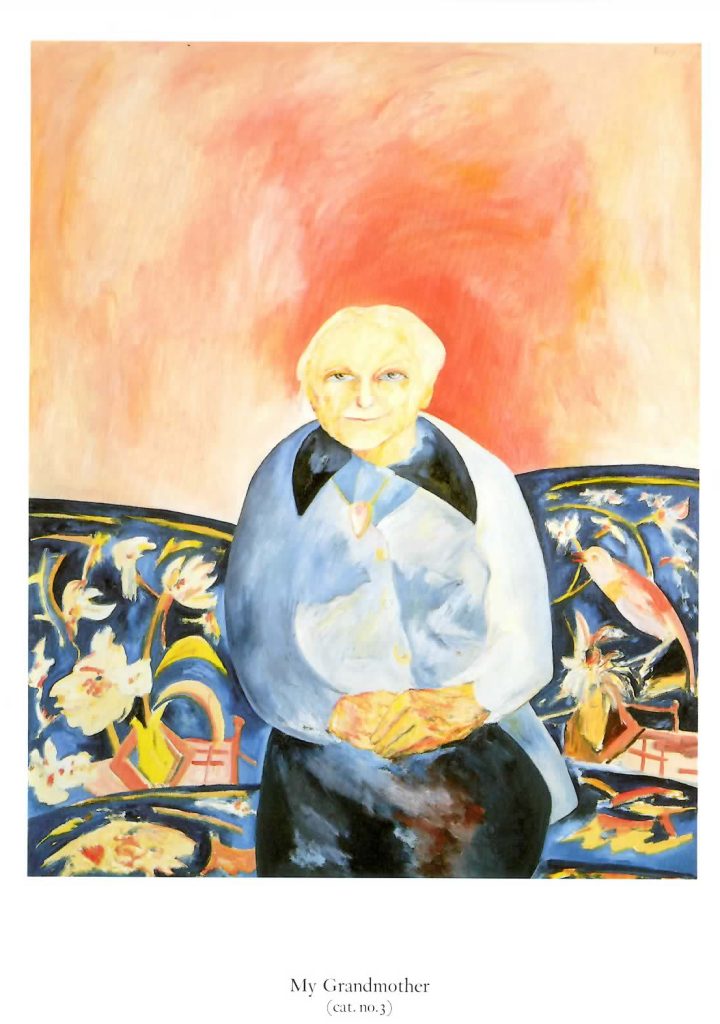
The mystical side of the Celtic family, amounting almost to a form of ancestor worship, occurs in two disturbing works of the early 1970s, both depicting Bellany’s grandmother. In My Grandmother, 1971, she appears as a beleaguered but still tenacious personification of age, casting ominous shadows against a background of darkly coloured and fluid spirit shapes: a powerful and mysterious being from local lore. In the 1972 portrait, painted after the death of Bellany’s grandfather, she appears more pathetically as a pale and wraith-like figure, sitting bolt upright in a vast bed, behind which hover three skeletal spirits, harbingers of mortality. The posthumous portrait of 1985 (cat. no. 3), in keeping with Bellany’s other recent works, is by contrast a serene and affectionate reminiscence of old age, painted in warm colours.
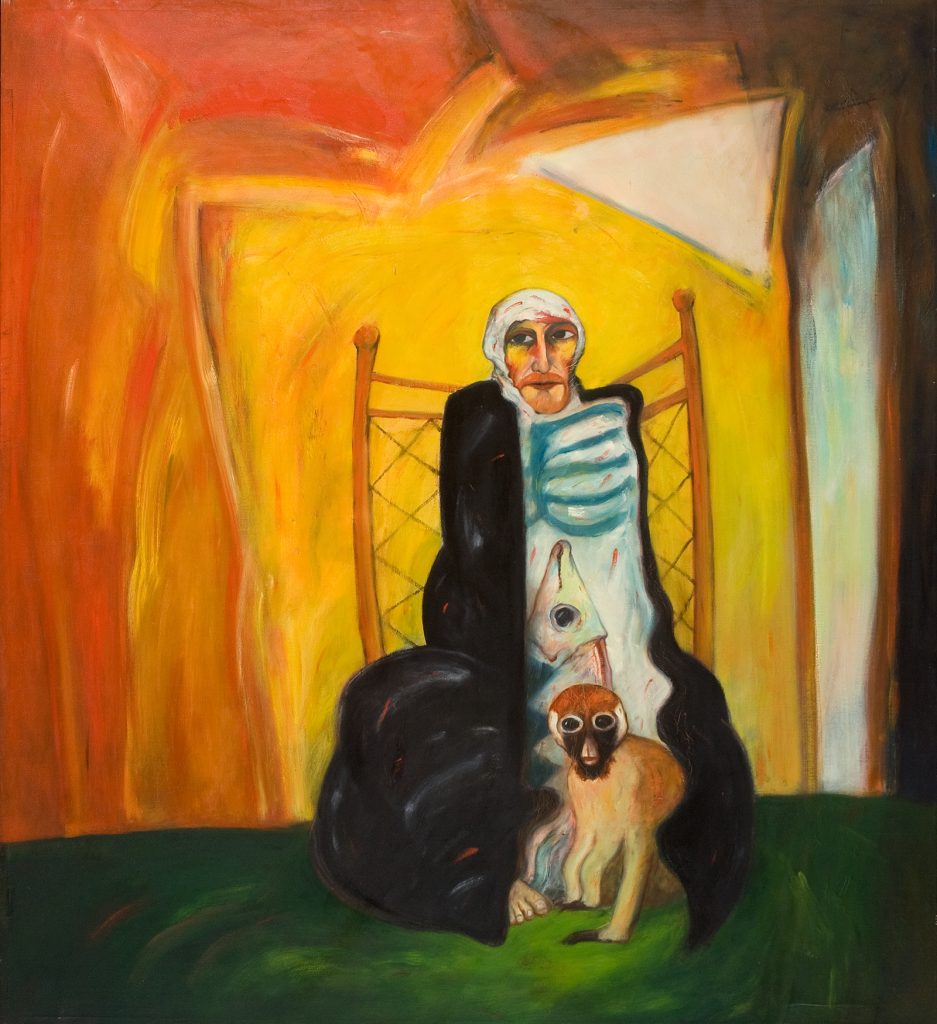
You’re 30 today, John. 175×161 cm oil on canvas 1972.
The intimations of mortality to be found in many of Bellany’s works of the 197os are also clear in a number of self-portraits, several of them painted on the artist’s birthdays. In You’re 30 Today, John, 1972, Bellany depicts himself shrouded, head bandaged, trapped against a bedstead, ribs visible in X-ray against the shroud and guarded by impassive figures of a monkey and a fish. In 1976, the artist is a wild, amorphous, glowering shape with a dunce’s pointed cap (reproduced Acme Gallery catalogue 1978, no.6); in 1977 he is completely transmogrified beneath the giant and inscrutable head of a capercaillie, one of Bellany’s several recurring metaphors for himself.
This spiral of increasingly near-vicious self-analysis and doubt is apparent in all Bellany’s major work of this period where death, sex, and the forces of nature battle with man for supremacy but is to a certain extent halted in a series of monumental if sombre double portraits celebrating his relationship with his second wife, Juliet. Self-portrait with Juliet, 1979 (Swindon Permanent Art Collection), and Mr and Mrs Bellany (fig. 3), a massive icon-like diptych, are the most straightforward of these, while Celtic Marriage (Tate Gallery) is the most cryptic and mysterious. A more direct link with the current series exhibited here is to be found in several other family portraits of this period, such as My Son Jonathan, 1980 (reproduced Ikon Gallery, 1983, no. 15) and My Father, 1980 (reproduced Ikon Gallery, no. 14) which are both more objective and less complex.
Looking through the immense number of Bellany’s paintings produced since the mid-196os, it becomes clear that his style is constantly changing and evolving from year to year, a fact which bears witness to his tremendous creative powers. It is not surprising therefore if the more serene and objective portraits of 198g are very different from the anguished and emotive images of the mid-1970s. But the mere fact that Bellany now undertakes portraits of friends and family with such regularity and is even prepared to accept an occasional commission, indicates a new, more outgoing outlook, a more settled existence and a greater acceptance of the human condition in general. Personal factors have no doubt played a part in this change: the upheaval of a trip to Australia in 1984, the break-up of his marriage with Juliet and the trauma of an extended and near-fatal illness were superseded by his recovery and by the renewal of his relationship with Helen. There is indeed something of a feeling of a new life in these recent pictures. If the Antipodean Self-portrait (cat. no.1), celebrating his return from Australia clutching the somewhat
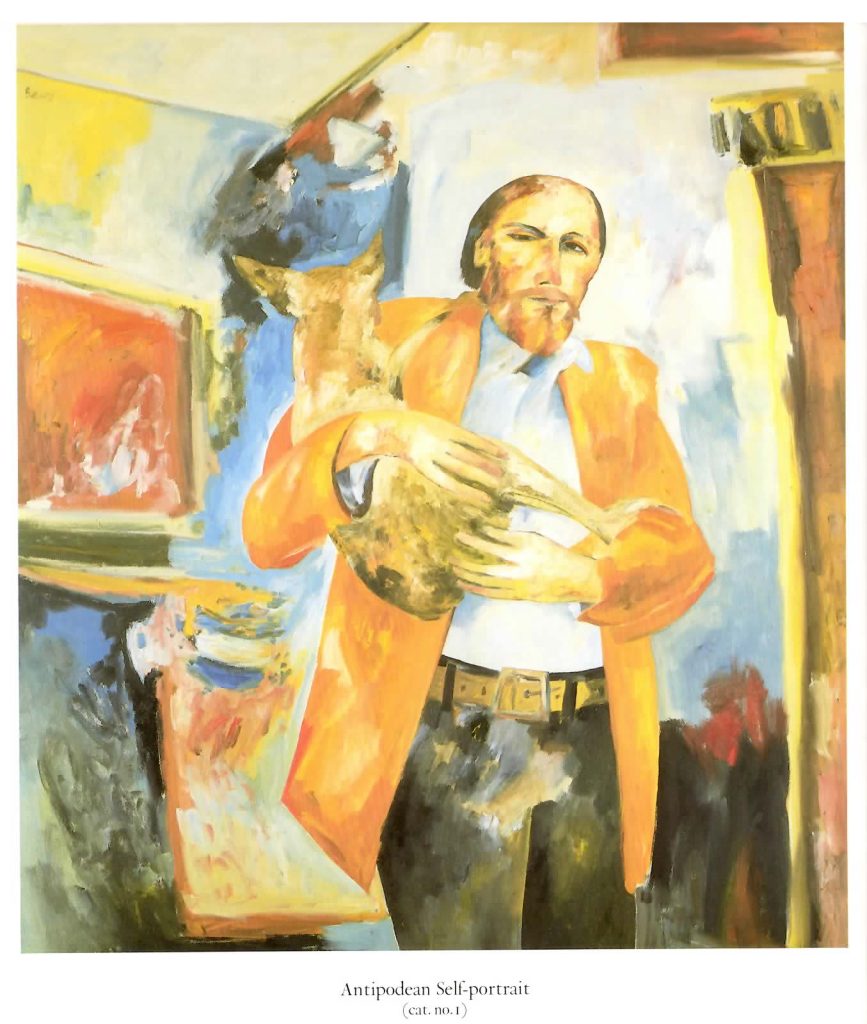
Antipodean Self-portrait. oil on canvas. 172.7 X 152.4cm. 1985
enigmatic spoils of his travels, presents a wry and slightly battered figure (the encounter with the kangaroo occurred on his first day in Australia at the house of the Clifton Pughs), the later Self-portrait (cat. no. o) painted at Lochinver, in which he returns to confront his maritime past, shows us a confident, indeed almost jaunty personality.
Stylistically, the greater emphasis on line in this and most of the other portraits in the exhibition may be a reflection of a renewed preoccupation with drawings in the early 198os, although these seem now themselves to have made way for watercolours of great beauty. Effortless, and with a mastery of technique and glowing colours unparalleled in contemporary painting, it is difficult to realise that these watercolours are in a sense the cream on the coffee, a relaxation from the hard work of painting, often finished in an evening. Importantly, those in the exhibition represent all the immediate members of the artist’s family; they include a haunting reminiscence of Juliet, painted shortly before her death, like the portrait of Bellany’s grandmother (cat. no. 3), a recollection in tranquillity. The magnificent goddess-like image of Helen (cat. no. 14) has a weight and presence scarcely to be expected in this medium and is in contrast to the more introspective large oil (cat.no.4) in which the background of earlier paintings by Bellany perhaps looks back over their relationship.
The backgrounds in all the large oils are indeed crucial to the understanding of the portraits and not only place the sitter in context but indicate the artist’s attitude to the sitter. Compare, for example, the two portraits of the Tate Gallery curators, Richard Morphet and David Brown (cat. nos. 7 and 2). The affectionately observed and extrovert portrait of Brown has several features instantly recognisable to those who know the sitter, the inevitable overcoat, the loud tie and the Christopher Wood painting behind the figure, Boat in Harbour, Brittany (1930), a tribute to Brown’s untiring research on the St Ives School.
By treating the Christopher Wood not just as a mere accessory, but as part of the reality of the portrait, indeed by relating it to his own paintings, Bellany characterises Brown as an extrovert and outgoing figure, actually seen investigating Christopher Wood in situ and about to move on to his next port of call.
The artist’s and the sitter’s mutual interest in contemporary maritime paintings is thereby also quite naturally written into the programme of the painting.
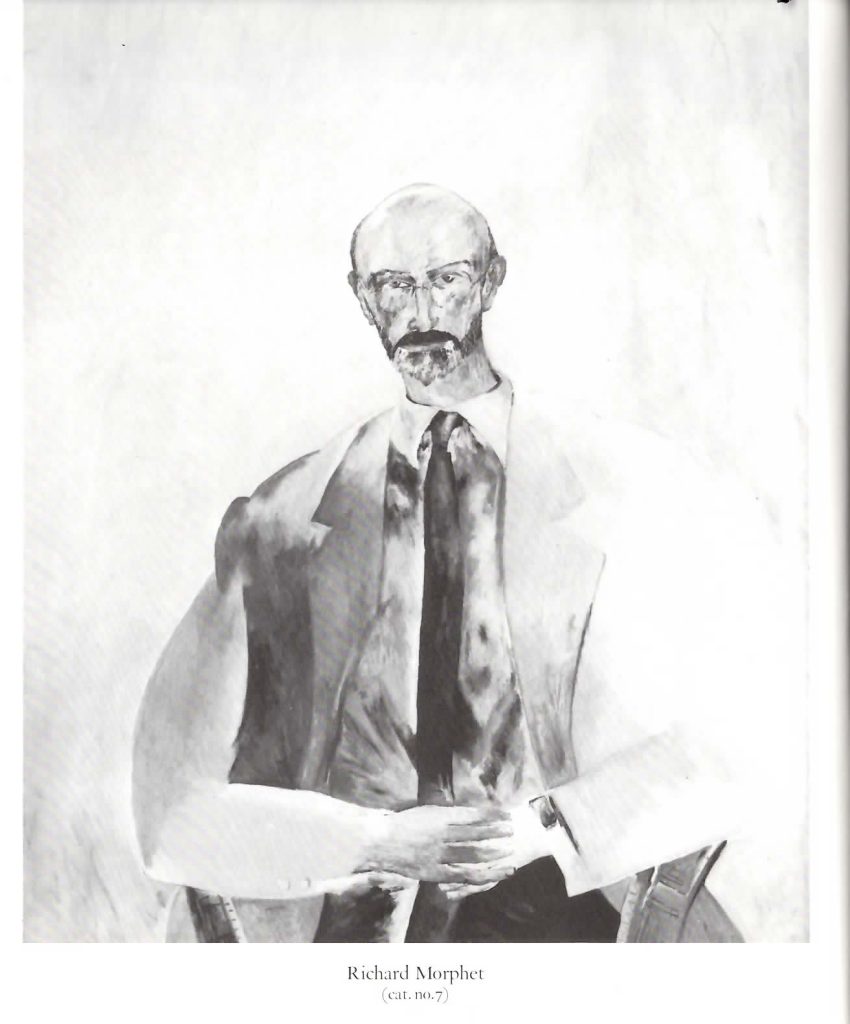
The portrait of Morphet, however, is considerably more intense and the background completely abstract. The inference here seems to be that Bellanv sees Morphet as a far more introverted and cerebral figure, perhaps more concerned with the theoretical side of art criticism (the sitter himself has noticed several points of comparison with portraits by Schiele in which spiritual insight may be suggested by expression and use of background).
A number of other portraits of artist friends and colleagues have been completed within the last two years, including two magnificent portraits of John Walker painted in Australia. Of the three in this exhibition, the one of that other leading Scottish painter, Alan Davie (cat. no. 6) takes most clearly the form of a tribute. Bellany gives us a stunning transcription of one of Davie’s own paintings and, placing the figure foursquare in front of it, cut off by the frame, integrates the artist and his work in a totally original way. What the painting may lack in the monumentality of the larger version of this work which includes a Bellany self-portrait, it gains in concentration and intensity.
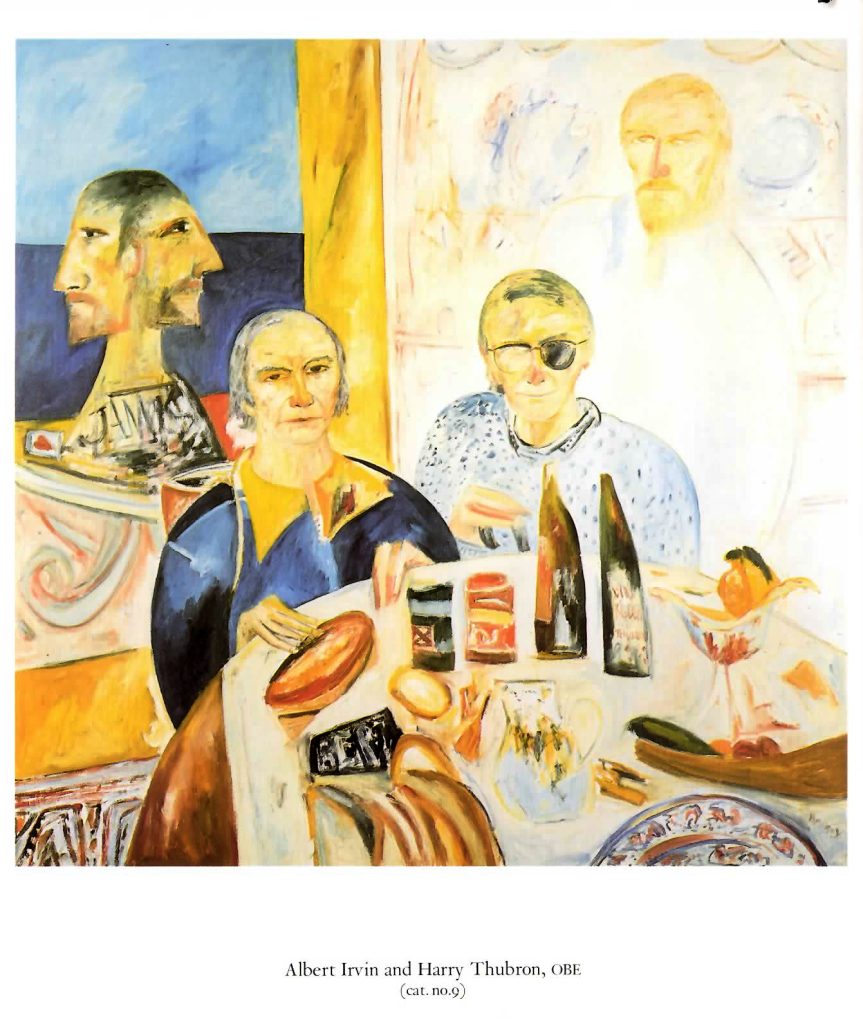
The portraits of Albert Irvin and Harry Thubron (cat. no. 7) and John Hoyland and Patrick Caulfield (cat. no. 8) may to a certain extent be seen within the tradition of an artists’ conversation piece, showing friends of the painter seated round a table after a meal. Neither picture, however, follows this basically realist tradition any further and both compositions are laden with metaphysical overtones. Bellany excuses himself from both tables and appears in spirit only. Caulfield and Hoyland raise their glasses to him, disguised as a Van Gogh self-portrait on the wall. He hovers ghost-like behind Harry Thubron and appears as the all-seeing Janus over Albert Irvin’s shoulder – Bellany has used the latter metaphor for himself on several occasions, particularly in the Self-portrait of 1972 (reproduced Drian Gallery catalogue, 1973, p.2). The posthumous tribute to Harry Thubron is instinctively associated with Bellany’s origins, and the dresser of his London kitchen fades inevitably before the greater reality of the strong, high horizon line of the sea at Port Seton on the left.
Caulfield and Hoyland are seen more in the urban context of the London studio, Bellany’s old easel being mysteriously transformed into a Caulfield painting, while Hoyland sports a sash proclaiming their allegiance to art.
Bellany’s renewed lease of enthusiasm for painting portraits and a passionate interest in all aspects of British life and culture led irresistibly to a desire to tackle a popular national figure as a subject for a painting. The National Portrait Gallery was only too glad to take advantage of this, and with an eye to remedying the almost total lack of sportsmen in its collection, an approach was made to the distinguished Somerset and England cricketer, lan Botham. Not since his student days in Edinburgh had Bellany undertaken a commissioned portrait.
The result was as unpredictable as might be expected, a forceful image of freshness and vitality quite unlike anything in the National Portrait Gallery’s collection (cat. no. 12). Although perhaps far removed from the conventional notion of a commissioned portrait, it follows the direct and somewhat over life-size format of an earlier Bellany portrait of a sportsman, former Chelsea captain, Micky Droy, and is in the truest sense of the word a genuinely popular picture, a massive icon of a folk hero of our times. Like some latter-day Siegfried, the golden boy of British cricket emerges proud and unassailable, unbowed after sundry skirmishes with sporting opponents and the media alike. Behind the golden haze, in true icon fashion, a mirror-like panel is emblazoned with the legends of Botham’s allegiances, both public (to England, Somerset and the Hollywood XI) and private (to his wife and children. By contrast, the pencil drawing which was executed prior to the painting is almost exquisite in its delicacy and reticence (cat. no. 19). Both Botham and his manager, Tim Hudson, who sat for his portrait on the same occasion (cat. no. I1) sport the colours of Hudson’s Hollywood XI.
All Bellany’s sitters, whether they be family, colleagues or heroes of the popular consciousness, become Bellany people, their own personalities inextricably woven into the artist’s life and outlook.
And yet, to how many is it given to recreate images of such power, exuberance and colour, and to form from likenesses at once so personal and individual, portraits so complete and full of meaning and life?
Robin Gibson