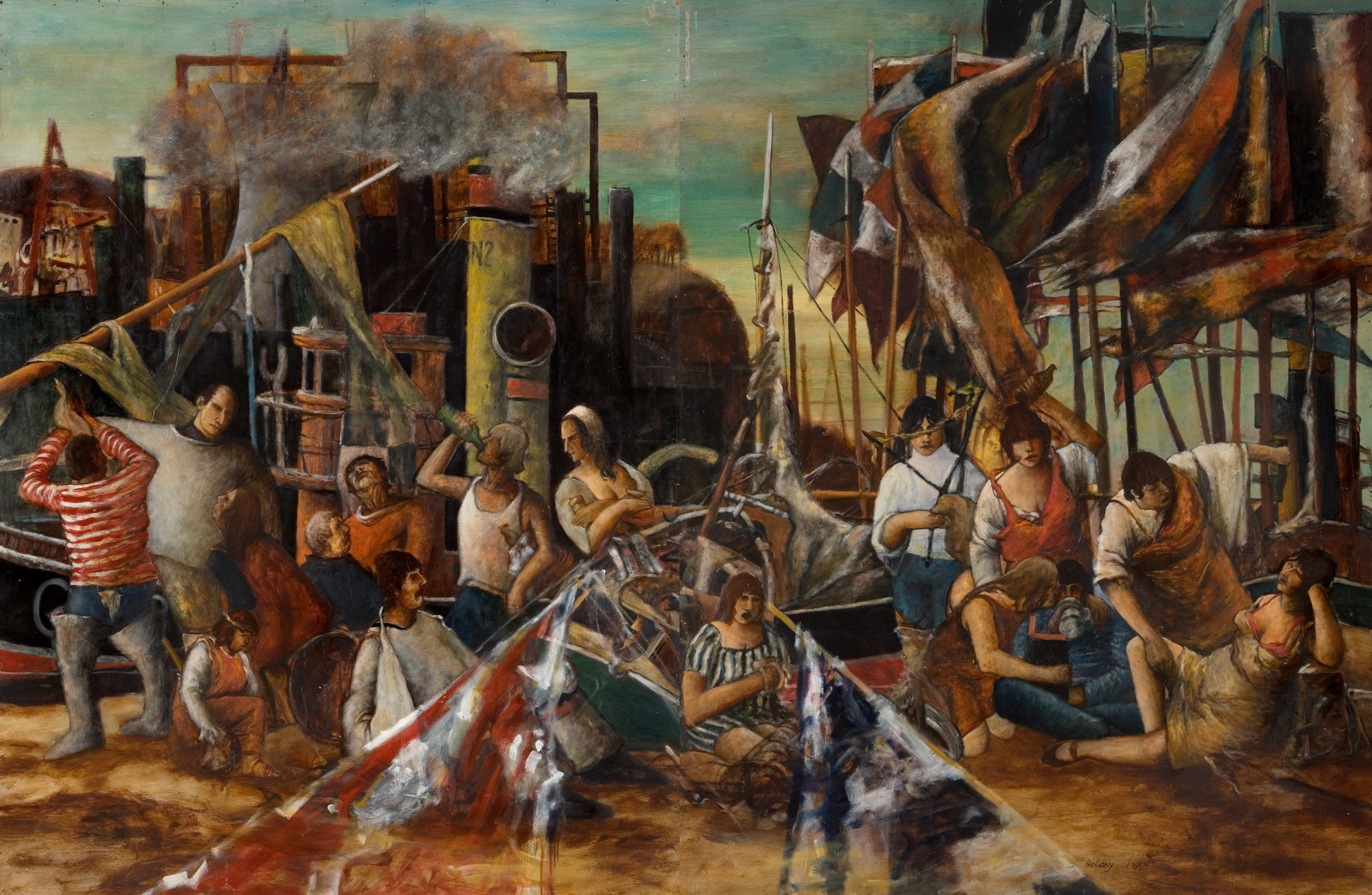
John Bellany was born in 1942 during the Second World War. His childhood was embedded in the secure warmth of the close-knit fishing communities of Port Seton and Eyemouth on the shores of the Firth of Forth in Scotland in which the Calvinist faith was the guiding light. All of his family life revolved round the church and the harbour and all of it would inform his spirit and vision. He was brought up to be in awe of the power of God upon whose mercy depended the daily survival of the fishermen at sea. As he grew older he would however become aware of another dimension to the life around him, one that co-existed but pulled away from the constraints of the Church. The hedonistic love of life and the call of the secular pleasures it promised.
Right from the beginning John’s work ethic was one of consistent life-long intensity but his early student years in Edinburgh which later continued when he enrolled at the Royal College of Art in London in 1965, could be said to be the most productive and fulfilling of his life. He was a student of twenty-two at Edinburgh College of Art when he produced The Box Meeting. It was painted on two pieces of hardboard, the biggest he could obtain, and the finished size of the work was 214 x 321 cms (or 7 x 10.5 ft). The scale and ambitious conception of such a piece of work is astonishing in relation to his young age and experience.
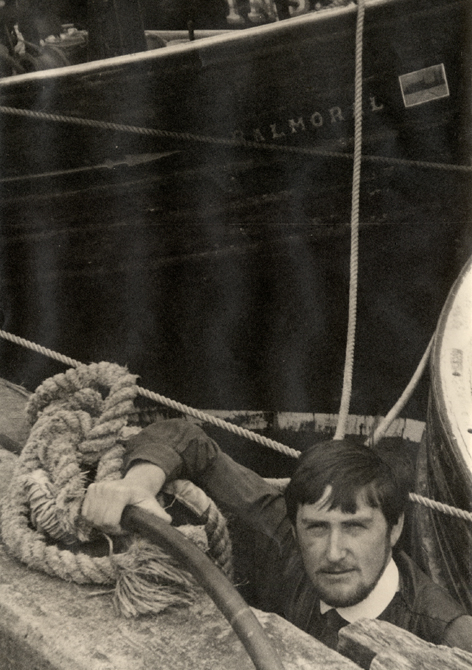
He had rapidly consumed all that was offered to him at Edinburgh College of Art simultaneously taking advantage of the freely available collections of impressive Renaissance masterpieces by Titian, Tintoretto, Rubens, Goya, Caravaggio etc on view in the Scottish National Galleries in the centre of the city. This is where the learning curve of his own personal quest really took off, centred on the belief that to be an artist of any depth you had to go back to the very beginning, to learn from the masters of European art whose genius still sang out in the present day. This was where he learned what he would call his ‘grammar and syntax.’ Not considering the purpose of painting to be the decoration of drawing room walls his sights were set on the great existential conundrums where everything came under scrutiny and was to be questioned including his own religious faith. This would lead to him finding and forming a voice and language of his own along with the large-scale presentation that he believed those issues demanded.
John had many heroes down the centuries from whom he learned and derived great inspiration. Among them was the Venetian Giovanni Bellini 1430 – 1516 (whom he would have liked us to believe was actually one of his ancestors)
The Box Meeting is a transcription of one of Bellini’s masterpieces, ‘The Feast of the Gods’ which he had first encountered in the Scottish National Galleries in Edinburgh onto which he transposed his own vision of an annual event that was the highlight of the fishing year in Port Seton.
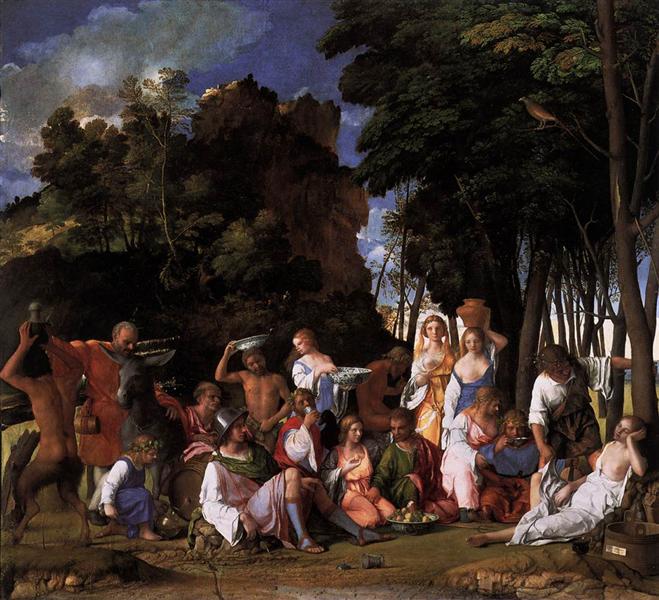
Giovanni Bellini’s Feast of the Gods 1514
In September at the end of the herring fishing a service of thanksgiving would take place in the Auld Kirk in the town to give thanks for the safety and good fortune of the fishermen throughout the season that had just ended. The box containing the deeds of all the boats would then be held aloft by the young fisher laddie specially honoured to undertake the important task and the deeds would be blessed for the season to come. The boy would then proceed out of the church through the town carrying the box followed by the fishermen in their dark blue fishing clothes and the fish wives all in vibrantly coloured traditional costumes, the families and children of the village accompanied by a band as well.
After the solemn and deeply meaningful religious blessing the event then developed into a full-blown celebration of life.
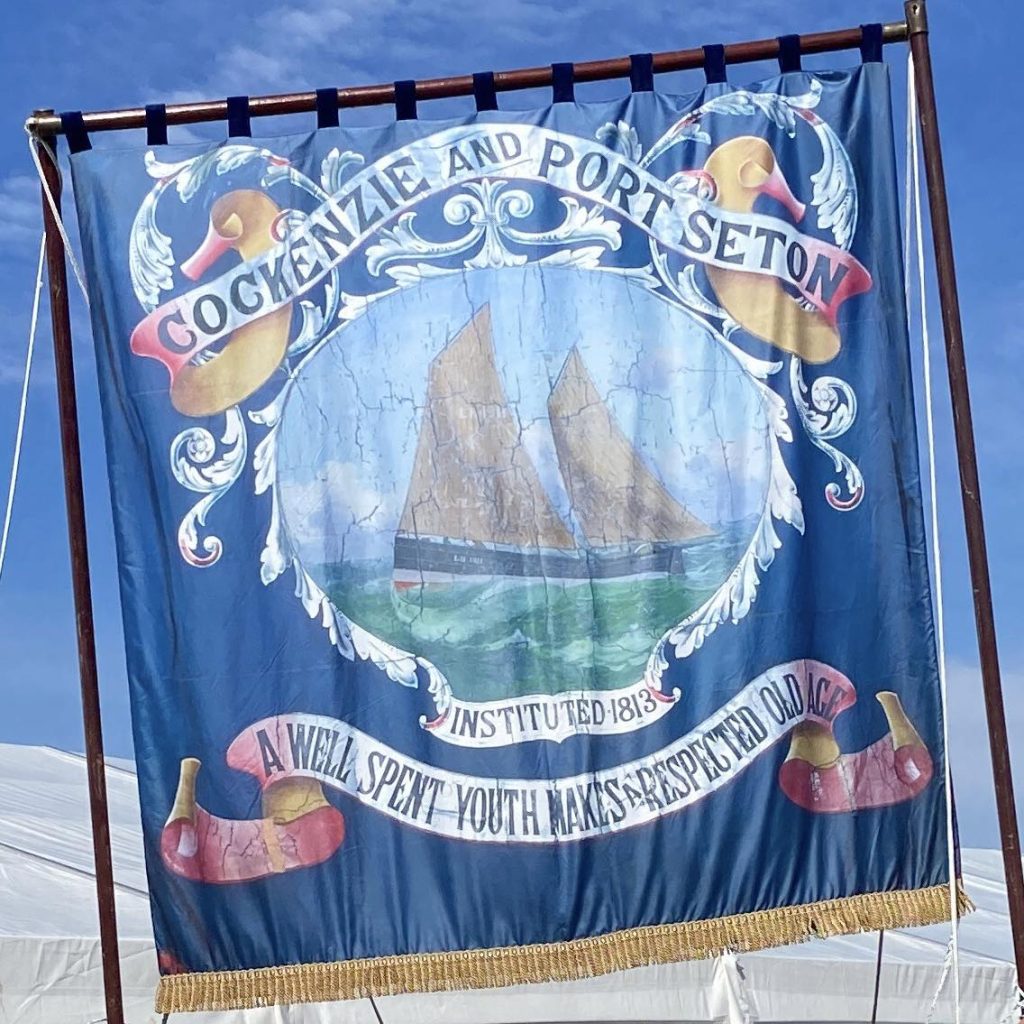
The streets would be festooned with flags and bunting and the boats in the harbour too would be flying flags that fluttered in the wind. There would be music and singing and dancing in the streets and later on there would be the Fishermen’s Ball, the culmination of the whole affair. By this time the sacred had given way to the profane at least by those who were less encumbered by the strictures of the church and much drinking and such like would carry the revellers on into the next day.
The Box Meeting is a unique work, a landmark painting, which John accomplished while in the force of an intense creative energy that saw him also completing, only a few months previously in 1964, another of his most important and impressive works, the great triptych, ‘Allegory’, involving the arresting composition of three mighty crucified fish which now hangs in the Scottish National Gallery of Modern Art in Edinburgh.
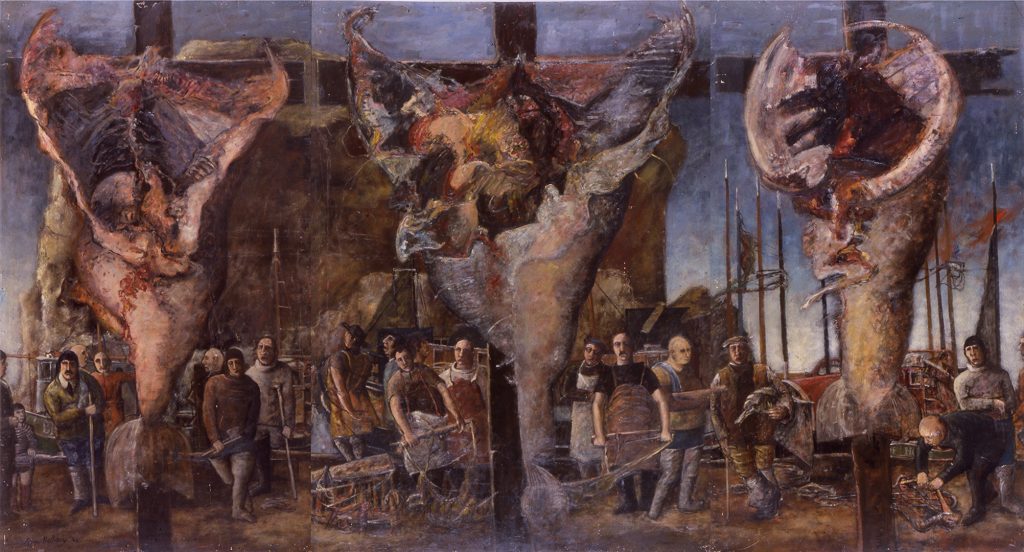
Allegory oil on board 1964
Measurements: Panel one: 212.40 x 121.80 cm; Panel two: 213.30 x 160.00 cm; Panel three: 212.50 x 121.80 cm
The Box Meeting has been kept within the family collection and has rarely been exhibited. Notably in recent times it was shown as a highlight of ‘A Passion for Life’ the major retrospective awarded John at the Scottish National Galleries RSA building in Princes St Edinburgh just a few months before his death in August 2013.
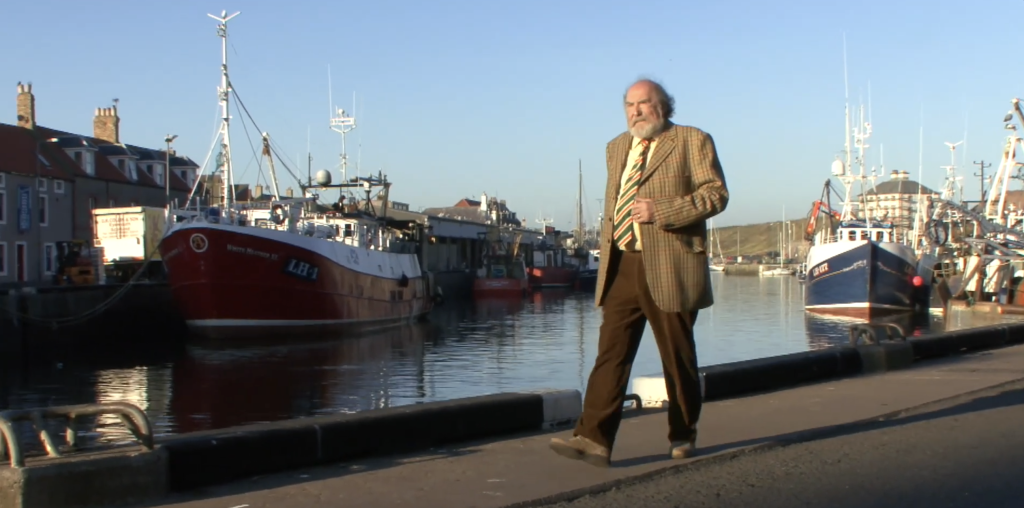
This last summer of 2025, the painting was exhibited for several months within St Giles Cathedral where John’s funeral had been held twelve years previously. This tribute was paid to him in conjunction with the concurrent critically acclaimed exhibition of his Self Portraits at the City Arts Centre Edinburgh. A special event accompanying this in St Giles was a concert performed by Stephanie Legg, a young saxophonist and her group, playing music she had composed inspired by John’s work.
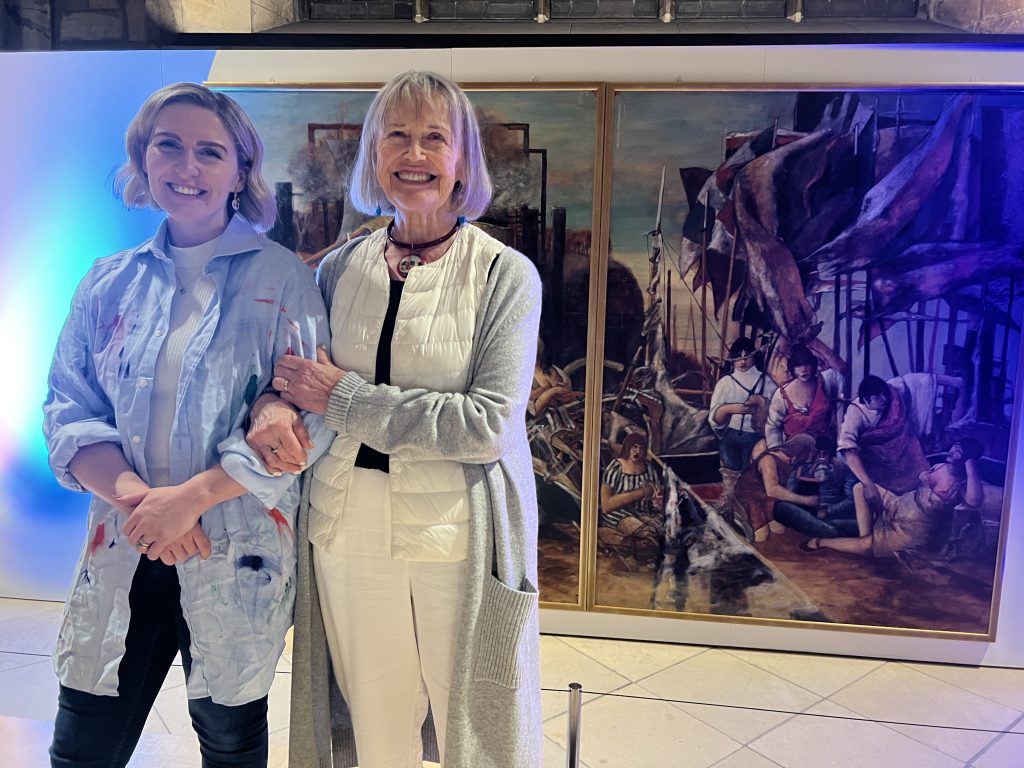
Musician and composer Steph Legg with John’s widow Helen, St Giles’ Cathederal, Edinburgh 2025
The Box Meeting is a rare and seminal work. It encapsulates the issues that inspired, confronted and followed him throughout his life, the dichotomy between the sacred and the profane.
The essence of his whole life’s work.
Helen Bellany
December 2025